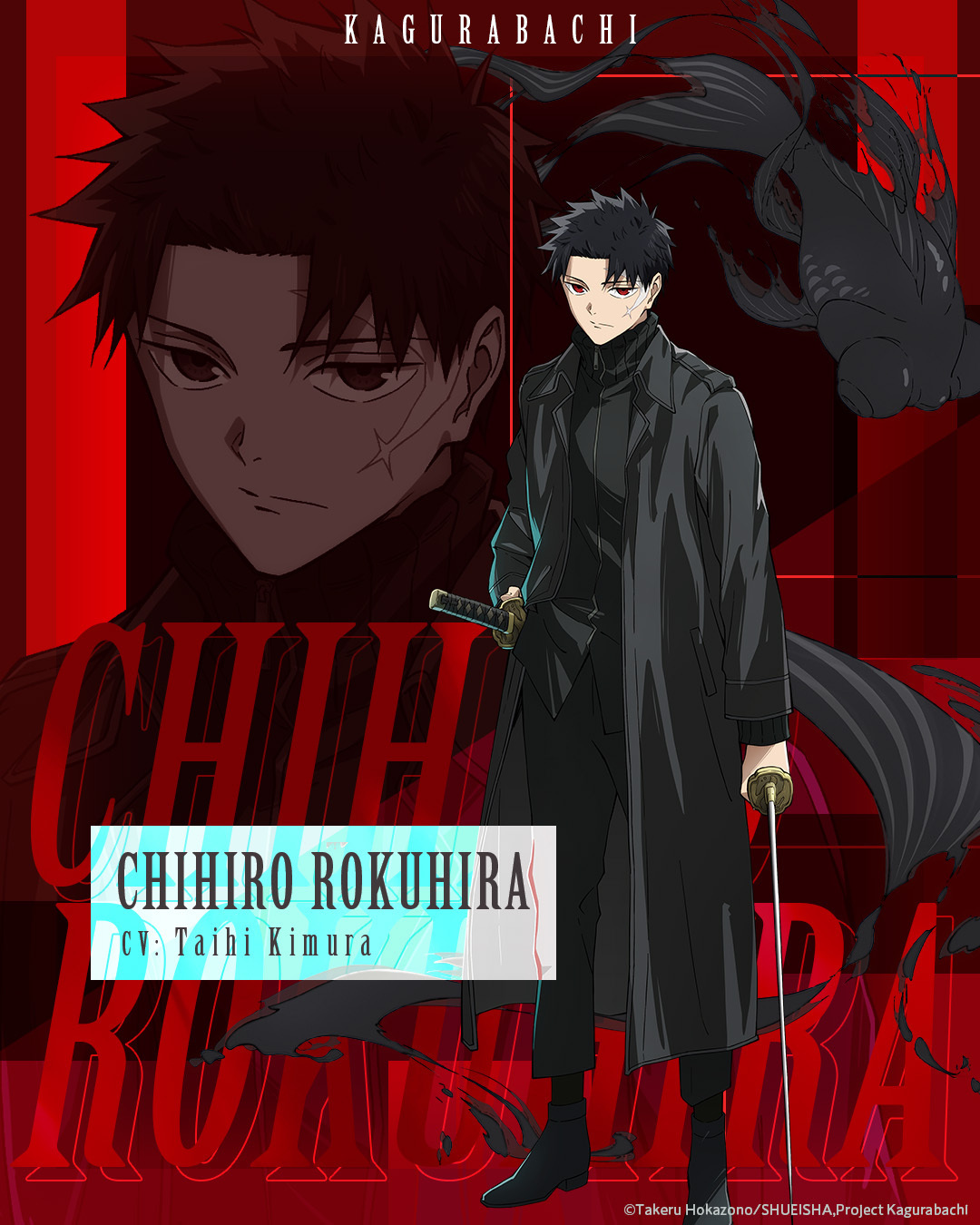
Overview
Chihiro grew up in isolation at his father’s workshop, training as a smith and as a swordsman in the quiet years after the Seitei War. Three years before the main story, the Hishaku murdered Kunishige and stole the six wartime Enchanted Blades. Chihiro survived, took Enten, the seventh blade, forged with him as a teenager, and went into the underworld with Togo Shiba to recover the swords and kill the men who ordered the raid.
He is typically stoic and economical with words, but he will not spend innocent lives for the hunt. That line is the difference between him and almost every adult who touched the blades during the war.
The public knows six Enchanted Blades. The Kamunabi want six. Chihiro’s early swagger, the seventh sword, the secret cellar, reads as shōnen inheritance. It is not. Enten exists because Kunishige could not smash the wartime steel on an anvil. Chihiro is eighteen. His birthday is August 11. His mother is Chiaki Soga; his uncle is Akemura Soga, the Sword Master whose Malediction the state filed as victory. He does not start the book knowing that ledger. The book is the education.
He works the Tokyo underworld with Shiba, then the 208th Rakuzaichi, then the Sanso circuit. He hands Magatsumi to the Kamunabi in exchange for keeping Enten and working inside the system. That is not surrender. It is the smith’s son treating the state as a tool the way the state treated his father.
Personality
Revenge is the engine, not the whole machine. Chihiro observes before he draws. He copies swordsmanship by watching, Uruha, Samura, Iori, and treats Enten as a partner rather than a trophy. After he learns what the Seitei War actually cost, the mission shifts: Enten was never only a weapon of succession. Kunishige made it to end the other blades.
The stoicism is workshop manners. He grew up over a cellar of swords that would not break, learning to look at ore the way his father did. He is economical because the house was economical. When he refuses to spend Char, or the auction prisoners, or a classmate Iori moves to shield, he is transmitting the one moral Kunishige actually left him. The coat is black with other people’s blood. The fish are from the kitchen.
He recognizes Sojo with disgust. Both of them think the smith’s work is the most important object in Japan. Sojo never had to live with the man. Chihiro did. That is why the first rival is a fan argument and not just a weather fight. Cafe Haru Haru is the other half of the same person: Shiba takes him there because the adult in the room knows the boy still has to sit down.
He will fake a school, wear a rebuilt arm, and let a clan take Enten if the blade can scout a Storehouse on its own charge. Purpose over pace. That is the same ethic he later beats Samura with. When the mission stops being “kill the men who ordered the raid” and becomes “fewer blades,” he is finally reading the brief his father wrote into the steel.
Abilities
Enten manifests spirit energy as water and three goldfish. Kuro is the black fish: flying slashes, later extended as Kuro: Shred. Aka is the red fish: absorb an attack, then spend it. Nishiki is the tricolor cloak: speed, density, and a built-in resistance to other Enchanted Blade ailments, Enten’s purpose showing through the technique list.
He briefly contracted the dying Cloud Gouger after Sojo’s death and spent its last charges at the Rakuzaichi. He is a keen enough student to fake Iai White Purity after watching its practitioners.
Kuro paints arm and edge in black water and throws a cut the size of the fish you called. Shred spends more spirit to throw many small ones. Aka drinks a technique and lets you speak it back for a short window. Nishiki is the household made into armor; the cloak shrugging off Spider and vitality-drain is not a random buff. It is the design brief. Against Sojo he reaches the True Realm first, with one arm already gone. Enten cuts Cloud Gouger in half, the first time one of Kunishige’s wartime swords is shown to be mortal.
At the Kyoto Bloodshed Hotel he copies Iai off Kuguri and the house style, eyes shut the way the curriculum demands. He is not Itsuo Shirakai’s student. He is a smith’s son who watches. The dying Cloud Gouger contract lets him spend Mei, cloaked Mei, and Mei: Shred, lightning that turns black because the blade is dying, the same “dark power” rule that later paints Suzaku. He walks into the auction with Kuregumo’s stump and a rebuilt arm. Magatsumi later bisects Enten. The pieces stay with him. Samura’s black Suzaku stalls the rot. By the end of Part 1 he is taking notes for a new Enten, and even a new Cloud Gouger, from what he still holds.
Story role
Chihiro is the viewpoint through Vs. Sojo, the Rakuzaichi, and the Sword Bearer Assassination arc. He hands Magatsumi to the Kamunabi in exchange for keeping Enten and working inside the system. By the end of Part 1 he has seen the Sword Master wear another man’s body, watched Samura spend his life, and started thinking like a smith again: notes for a new Enten, and even a new Cloud Gouger, from the pieces he still holds.
In the Vs. Sojo chapters he stays on Char against Azami’s advice. Sojo takes her. The Anti-Cloud Gouger Special Forces die around the compound. Four of the six are gone; Hagiwara loses his legs; Kazane loses an arm. Chihiro loses an arm and still finds the True Realm. Sojo chooses Datenseki suicide. Chihiro keeps the pieces of Cloud Gouger. The revenge story has learned it will have to protect someone who cannot hold a sword.
At the 208th Rakuzaichi, Shinuchi is listed. He meets Hakuri and Hiyuki. He lets the Sazanami take Enten so the blade can scout the Storehouse. On auction day he walks in on Cloud Gouger’s last charges, spends them to take Enten back, and keeps the building from becoming a second island while Kyora dies touching Magatsumi. Prisoners leave. The auction ends. He gives the Kamunabi the masterpiece and keeps the seventh blade by joining them. Then a Sanso is attacked, and the next book starts on a train.
The Sword Bearer Assassination arc sends him to keep Uruha alive, then to Iori, then to Samura. He tells Samura the truth Kunishige left in Enten. Samura opens his eyes. In Tokyo, Kasen’s leak is on the table, Kudo dies for Hakuri, Yura spends Magatsumi without drawing it. Yura, losing, gives the body to Akemura. Magatsumi breaks Enten. Samura’s flames go black. He buys Chihiro a corridor and dies. Tobimune goes to Iori. Akemura is loose in the Kamunabi. Chapters 106–115 spend the last of the present tense and hand the book to a swordsmith and a princess on Irishima.
Relationships
Kunishige is the house. Chihiro inherited the seventh blade and, later, the reason it was made. Akemura is the maternal uncle whose flowers are the war’s real ending; Chiaki Soga, Akemura’s sister, is the mother Part 2 returns to on Irishima. The family is a smith, a princess with foresight, and a patriot the Kamunabi filed as a hero.
Shiba is the adult, Cafe Haru Haru, extractions, the friend who stayed when the smith hid. Hakuri is the son of a house that treats children as stock; Chihiro is the first person who treats the discarded Sazanami as a partner. The Storehouse is why the Kamunabi bother to keep Chihiro: Hakuri can un-arm and re-arm bearers without a siege. Char is the first rescue that was not a sword. Iori is what happens if you erase the father instead of explaining him; Chihiro copies her style and then walks her toward the man who spent himself keeping her out of the ledger. The Masumi serve that same household until Samura frees them.
Sojo is the dark mirror of Kunishige-love: a customer, not Hishaku, who understood the blades as craft and never met the bowl. Hiyuki starts as the state with a personality and becomes the reason the auction actually ends. Yura is the named target, the man who planned the raid so he could one day hold Magatsumi. Samura and Uruha are the wartime bearers Chihiro has to keep alive long enough to tell them what Enten was for. Uruha treats the Rokuhira name as a vocation; seeing the son refills the oath Kunishige’s death emptied.
Notes
Hokazono has said goldfish beat koi because the fin-to-body ratio read better on the page and because the bowl of fish was a better symbol of Chihiro and Kunishige’s daily life than a carp would have been. The fighting language is a household object first.
He is eighteen. Birthday August 11. Voiced by Shoya Ishige in the voiced comic and Taihi Kimura in the Cypic anime; the official character art on this page is the anime sheet. Hokazono has named Chihiro versus Sojo as his favorite fight drawn so far. White, black, and red match a coat already stained. The fish stayed cute on purpose so the sword fights would not.
He is the jacket face of Volumes 1, 2, 3, 4, 5, 6, 7, 8, 9, and 11. Volume 9 is the single-figure Enten book, where the brief is said cleanly against Samura. Volume 11 puts him in snow with Aka and Kuro. Chapter 1’s color opening is the workshop and the raid; chapter 9 is the first Enten versus Cloud Gouger page; chapter 83 is where Enten’s purpose is spoken out loud. Official chapters: VIZ / MANGA Plus.
People who touch this story
Chihiro copies Iai off Kuguri at the Kyoto Bloodshed Hotel before he ever draws against Samura with his eyes shut on purpose. The hotel is a school. Kuguri is an unwilling instructor. Tafuku is the Kamunabi partner who starts as an enemy at the auction and learns the same lesson Hiyuki does: this boy will spend a body without spending the people inside the building. Kasen is why the raid happened; Chihiro’s deal with the bureau (Magatsumi to the state, Enten in his hand) assumes a director who wants blades sealed. Kasen wanted them used. Those are not the same Kamunabi.
Hinao’s Cafe Haru Haru is the civilian door Shiba uses when the coat is too loud. Voiced comic: Shoya Ishige. Cypic: Taihi Kimura. Official character art on this page is the anime sheet. By the end of Part 1 the notes in his head include a new Enten and even a new Cloud Gouger, which is how you know the revenge engine has become a smith’s ledger. Part 2 does not stay with him. It goes to the kiln that will make the ledger necessary. See Part 2 and Enten’s kit.
The rest of the ten, from his side of the corridor
Toto is why a cafe and a hotel are never dark enough. Blood is a signature. The fire-gate is how the loud ones leave. Yukisada is why Azami cannot simply call Shiba: a seventeen-year-old who is also a government barrier. Hakuri is the key that fits that door. Bingo fills headquarters with mouths that punish you for breaking them. Uran was already in the workshop the night the father died. Chihiro’s commute is three years away from her breath and still inside it. Two of the ten stay unnamed.
The hotel classroom is its own page now. The Storehouse is architecture, not only Hakuri’s trick. The ACG are six people and four graves, the state’s first offer, the reason he knows a named unit can snap. Hinao is the counter. Madoka is the chapter-8 promise Sojo killed. The Part 1 long cut is the commute written as one page. The synopses are the same commute by spine. When the kiln finishes a blade, he will still be the boy who would not spend innocents, holding notes.