Full spoilers for the end of Part 1.
Movement one, Uruha and Samura
The deal with the Kamunabi has a first assignment. A Sanso is attacked. Chihiro and Hakuri are sent to keep Yoji Uruha alive. Uruha was chosen young and never recovered from being chosen. Kunishige’s death emptied him; Chihiro’s existence refills the oath. The Hishaku send Hiruhiko and Datenseki infantry at the train to Kokugoku. Blood Crane boards. The fight falls into a kabuki house because Hiruhiko is the one sent to make a scene.
Hakuri’s Storehouse is why the assignment can work at all. He can register a bearer and a blade and move steel without a siege. At Senkutsuji he returns Tobimune to Seiichi Samura. Samura clears the temple at a speed the rest of the bearers treat as weather, then cuts Uruha down. It looks like a Hishaku pact. Guilt over the Malediction put Samura in a room with Yura: kill the other bearers, return the blades, kill the Sword Master, then die with the ten. What he actually does to Uruha is Suzaku. Kill the Lifelong Contract. Keep the man. Kumeyuri comes off the board. Uruha wakes in a morgue with Crimson Recital limping back.
Movement two, Iori
Samura hangs Owl over the country. Tobimune was forged for support: Crow to reposition, Owl as reconnaissance at the scale of Japan, Suzaku as fire that heals the wielder and burns everyone else. After the war he taught those flames to raise the dead. Owl listens for Enchanted Blade noise. The map of Part 1 becomes a blind man’s hearing.
The Masumi, Ro, Moku, Sumi, take Iori to the Kyoto Bloodshed Hotel. After Iori’s mother died, Samura tried to be a parent and a war criminal in the same house. When Yura came to the door with the truth of the Malediction, Samura had the Masumi erase him from her memory and sent her away. The spell frayed because she still loved him. It broke when she moved to shield a classmate, Iai, eyes shut, the way the style is supposed to be used. She decides she wants the memories. Everything after that is a daughter walking toward a man who already spent himself trying to keep her out of the ledger.
Chihiro learns Iai by copying Kuguri and the house style. Itsuo Shirakai’s speed school, mocked until it killed the mockers. Samura and Uruha are the famous students. Iori and Chihiro copy it. Eyes closed is the curriculum, not theater. Hiruhiko wrecks the hotel with Play. Kumeyuri is theater: Banquet takes the senses, Play takes the set. Hiruhiko, who does not love objects, discovers the extension, if Play is respect, contempt is a wrecking ball. The upper floors go. Samura arrives. Feathers, banquet, goldfish. Chihiro and Samura occupy the same page as two readers of Kunishige who have not yet agreed what the work was for.
Movement three, the basement
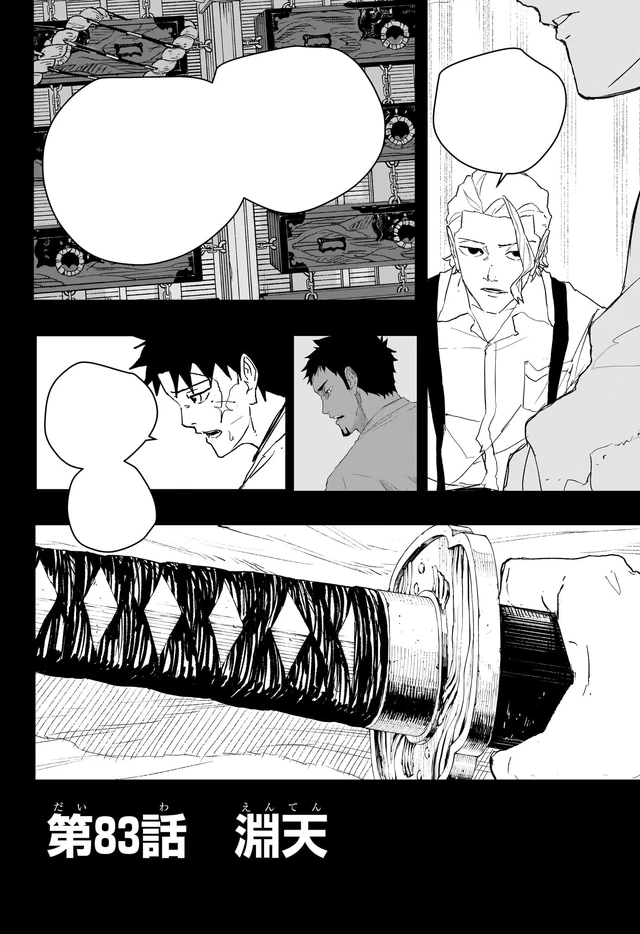
Chihiro tells Samura the truth Kunishige left in Enten. The seventh blade is not a heirloom. It is a retraction. Its True Realm is Magatsumi’s death. Nishiki’s resistance kit is the brief made visible. Chapter 83 says it cleanly. Chihiro beats him with purpose, not pace. Samura opens his eyes. He heals them. He sees his daughter.
In Tokyo the present-tense plot finishes its homework. Kasen’s leak is on the table: a Kamunabi director spent the smith’s address to the Hishaku, which is how you get a raid three years ago and a basement now. Kudo dies for Hakuri. Uruha walks again, old sorcery back, into the Kamunabi raid to keep the Storehouse that walks alive. Yura spends Magatsumi without drawing it, flowers at range, the masterpiece as a remote. Yukisada sits in the barrier as vessel. Shiba dumps the fight onto the street because teleportation is still the only adult magic that does not need a national weapon.
Chihiro and Samura meet Yura. Yura wanted the Sword Master dead so the Lifelong Contract would open. Then he spoke to Akemura and changed the math. He is losing. He gives the body anyway. Akemura takes the offered flesh and goes back to work. Magatsumi can overwrite another body. The patriot who decided the island should not exist is loose in the building that filed him as victory.
End of Part 1
Magatsumi breaks Enten. A retraction can fail. That is the book being literal. Samura’s flames go black, Suzaku with the lights off, the life-for-power rule strong enough to argue with Malediction. He buys Chihiro a corridor and dies. Tobimune goes to Iori. The support blade does the job Kunishige assigned it eighteen years late. The Iai style as ethics: one cut, no extra motion.
Akemura is loose in the Kamunabi. Chihiro has seen the Sword Master wear another man’s body, watched Samura spend his life, and started thinking like a smith again: notes for a new Enten, and even a new Cloud Gouger, from the pieces he still holds. Chapters 106–115 spend the last of the present tense. “Karma.” “Enten vs. Magatsumi.” “Tobimune vs. Magatsumi.” “As a Swordsman.” “Rock.” “Kunishige Rokuhira.” “Swordsmith.” The book hands itself to a swordsmith and a princess on Irishima. Volume 12 is expected to close this movement and open the war book. Part 2 does not start as a flashback courtesy. It starts because the present tense ran out of lies.
Related pages
Volume 10, The Swordsmen, is Natsuki, Hokuto, Uruha, Yura on one jacket. Kasen’s leak is printable in that book. Kiri escorts Hakuri toward Shinuchi. Yukisada sits in the barrier. Tafuku’s perfect act is not the HQ’s tool; the basement does not use referees. Kuguri’s hotel classroom is how Chihiro arrives at Enten versus Tobimune with his eyes already shut. Ibuki is the grave under Cloud Gouger’s residual charges. Subaru is relocated rather than spent. The org pages for this arc are Hishaku and Kamunabi.
Related pages
The hotel is no longer a paragraph. Kyoto Bloodshed Hotel holds Sengoku, Reigen, Toto reading a head, Kuguri’s classroom, Play’s demolition. Owl over Japan is why two Enchanted Blades in one building end the week. The leak as policy is why the raid was stationery. Toto, Yukisada, Bingo, and Kudo are people instead of captions. Hagiwara is the first book’s cavalry leftover, still in the building, still not enough for a regenerative Vessel. The Part 1 long cut walks the three movements into this basement. The title essay is why “Heroes” has quotation marks.