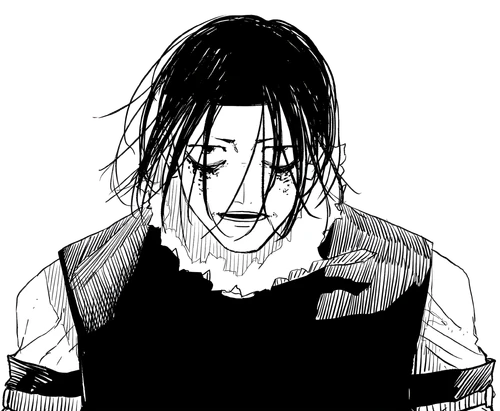
Genichi Sojo’s Bathhouse Quest
Two parts, packed with the tankōbon: Sōjō Gen’ichi no Ofuro Tanbō. Sojo, off the murder clock, rates baths. It is the same curiosity that makes him a Kunishige scholar. He wants to know how a thing is built, a blade, a body, a tub. English readers who only met him as “the Cloud Gouger guy” meet a sitcom villain who still sounds like himself. That is why the extra works. It does not apologize for chapter 18. It reminds you he was a person with hobbies while he was a disaster.
The worst-fan essay is the long version: he loved the work and never met the house. The bathhouse pages are the short version. Same organ. He is thirty, an arms dealer, sincere about craft in a way Chihiro recognizes with disgust. On Sunday he is weather and a crater. In the extra he is a tourist. Volume extras are where Jump lets a serial menace keep a hobby without filing it as redemption. You do not come away thinking the compound should have gone differently. You come away knowing he would have had an opinion about the water heater.
Soya Sazanami’s Memories, Begone!
Sazanami Sōya no Modoranai de Kioku. The older brother who treated Hakuri as defective stock gets a gag about memories he would like to misplace. Four pages of the clan’s emotional illiteracy as a joke. Read it after the Rakuzaichi if you want the auction house to feel like a family.
Soya is one of the Tou, the household military with Tamaki, Enji, and Tenri. Hakuri is the error that ends the firm. The extra does not decorate that fact. It makes the family’s habit of misplacing feelings into a title. Samura had the Masumi erase him from Iori for a reason that was almost love. Soya wants memories gone because the clan never learned the other motion. Two erasures in one book. Only one of them is trying to keep a daughter out of a ledger.
Why the tankōbon
Hokazono’s Jump one-shots before the weekly, Enten, Farewell! Cherry Boy!, Chain, Madogiwa de Amu, Roku no Meiyaku, are a different pile. Those are pre-serial tests. The volume extras are the serial already in motion, given four pages to be a sitcom without leaving the voice. Roku no Meiyaku is the one people point at when they say he already knew how to end a short on a debt. The bathhouse quest is how he refuses to let a dead fan be only a crater.
Buy the volumes for these. They are the Kanzenshuu-style reason the tankōbon earns its spine. Japanese Jump Comics collect them with the chapters; VIZ’s English editions follow the same extras when the volume lands. See the volume guide for the chapter maps, and the chapter index for the magazine titles. The extras are why a shelf of eleven spines keeps a sitcom in the same voice as the war.