TV Tropes files Sojo as a loony fan and it is not wrong. It is incomplete. He is the only early villain who can talk about the Enchanted Blades without sounding like a government memo. He wants to mass-produce Kunishige. He wants Char’s clan as a stabilizer. He wants Cloud Gouger to “gain slaughter” and is delighted when it does. That last wish is True Realm as autobiography.
Chihiro hates him and recognizes him. Both of them think the smith’s work is the most important object in Japan. Sojo never had to live with the man. He never saw the bowl, the picky dealer, the cellar of swords that would not break. Fandom without the household becomes a factory. The bathhouse extras are funny because the curiosity is the same organ as the cruelty.
He is not Hishaku. Recaps that blur this cannot later explain Yura. The men who killed Kunishige sold him Cloud Gouger in early October. He used it to chase Char and to chase a production line. Kyonagi cells as fake Kunishige-eyes. Stones that hold for a few minutes. Tenri dies on one of those stones later, trying to impress Kyora, which is Sojo’s homework killing a different son. The Anti-Cloud Gouger Forces die around him because the state built six people to solve a fan and the fan had weather.
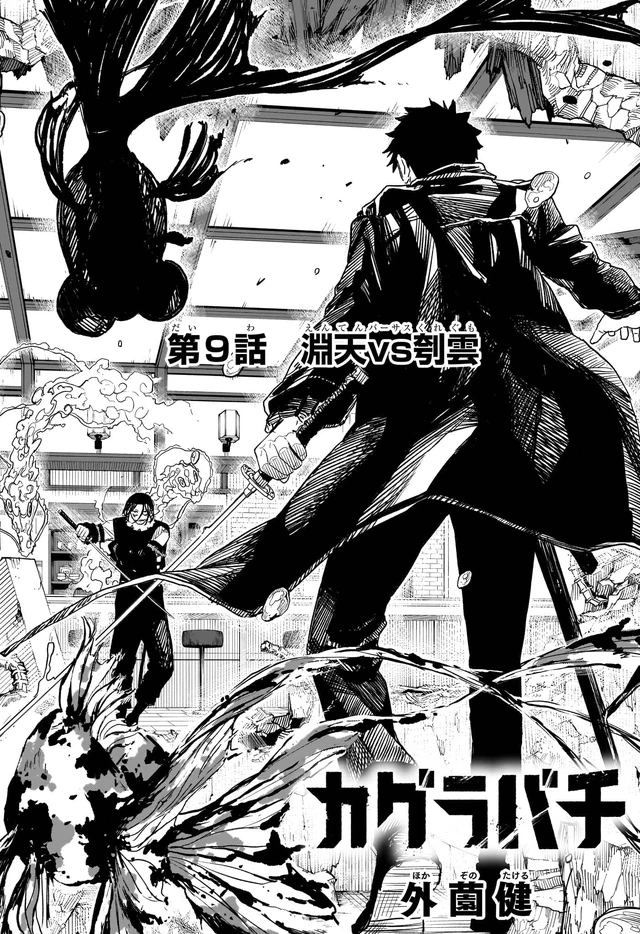
Chapter 9 is the first time two readers of Kunishige occupy the same panel. Volume 2’s jacket puts Chihiro and Sojo on opposite weather: night steel versus storm cyan, blood on black. Hokazono has said the Chihiro vs Sojo fight is his favorite he has drawn so far. That is not because the lightning is pretty. It is because the argument is clean. One of them lived with the bowl. One of them loved the lock.
Enten cuts Cloud Gouger. The wartime sword is mortal. Sojo fuses with unstable Datenseki rather than admit the experiment failed. A fan who cannot have the work intact will become a crater. Chihiro keeps the pieces and spends their last Mei at the Rakuzaichi. That is the other reader’s ethic: the blade still has a use that is not slaughter. Mei: Shred turns the lightning black because the blade is dying. Even Sojo’s weather kit, in the son’s hand, learns a darker honesty on the way out.
The bathhouse extra, Sōjō Gen’ichi no Ofuro Tanbō, is the same man off the murder clock, rating tubs. He wants to know how a thing is built: a blade, a body, a bath. English readers who only met him as “the Cloud Gouger guy” meet a sitcom villain who still sounds like himself. The extra does not apologize for chapter 18. It reminds you he was a person with hobbies while he was a disaster. That is why he is a fan and not a costume.
Every later monster is a larger Sojo argument. Yura is the collector: he decides which blade goes to which monster, puts Magatsumi on the auction block, signs Samura, then recognizes Akemura as a colleague. Kyora is the auctioneer-fan of a two-hundred-year market; he will spend children to keep the catalog open. Akemura is the patriot who finished the thought at 200,000. Hiruhiko is the child who thinks friendship is a stage, Play as contempt, a hotel for a wrecking ball. The book keeps asking: if you love the blades, who are you loyal to, the steel, or the person who was sorry he made it?
Chihiro’s answer is the house. Sojo’s answer is the factory. The Vs. Sojo arc teaches the rules so the later rooms have something to break. A protagonist who will not spend Char. A fan who will. Everything after the crater is a larger version of that panel.