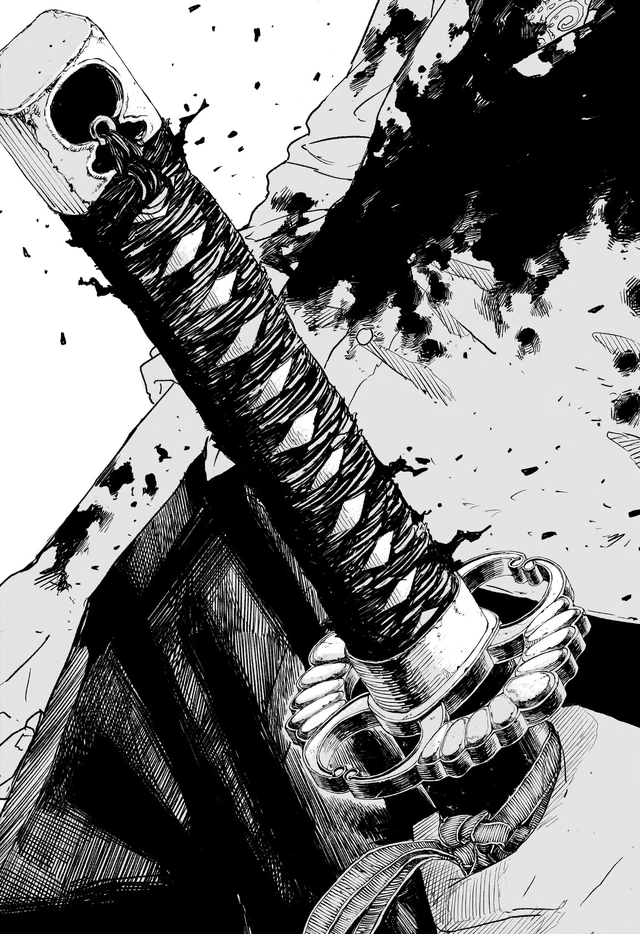
Malediction is not one of Magatsumi’s insect names. It is an extension, True Realm as policy. Akemura decides the islanders should end, and the blade learns a wider mouth. Flowers are the visual because the sword already ate people as gardens; he simply asked for a field the size of a nation.
The other bearers fail in the room and then succeed in the press. Kunishige hides. Samura blinds himself twice: once as training, again as fatherhood. Kasen, years later, still thinks the blades are a path to order, which is how you get a director leaking a smith’s address to the Hishaku. The cover-up is not a twist. It is the water the present-day plot has been swimming in since page one.
Akemura is not a berserker who lost the plot. He is a patriot who decided the island should not exist. Magatsumi is the only Enchanted Blade without a tidy three-technique kit and the only one that can overwrite another body. After the flowers finished their work he handed himself in. The Kamunabi built a myth instead of a trial. If he dies, the other five wartime contracts die with him. That knot is why nobody simply executes the monster in the basement. The official sentence is: once Magatsumi entered the field, Japan could walk onto the island. The unofficial one is 200,000 civilians after a peace.
Sojo is the small version of the same hunger. He wanted Cloud Gouger to gain slaughter and called that honesty. Akemura finished the thought at national scale. Kyora is the auctioneer’s version: he unsheathes Shinuchi to keep a two-hundred-year market open and almost becomes someone else. The Rakuzaichi almost becomes a second island. Hiyuki and Chihiro keep the building from blooming. The threat is already in the present tense before Part 2 has a name for the talks.
Samura’s pact with Yura is guilt trying to do surgery. Kill the bearers, return the blades, kill the Sword Master, die with the Hishaku. What he actually does to Uruha is Suzaku: kill the contract, keep the man. He erases himself from Iori because he knows what “hero” meant on the island. Volume 8, Dawn, is where the Malediction is spoken aloud in the hotel. Volume 11 is titled Heroes. The quotes in the chapter index sit on “Strongest,” “Sword Master,” “Heroes” for a reason. The press already used those words. The book puts them in quotation marks.
Yura’s conversion is the scary political joke. He wanted Akemura dead to open a contract. He meets the man and recognizes a colleague. Chihiro’s generation inherits both the flowers and the lie about who planted them. The Hishaku spent three years trying to open Lifelong Contracts by killing bearers. Then their leader offers the author of the atrocity a body, because a lucid patriot is more useful than a dead lock.
Part 2 does not invent the crime. It walks into the room where the crime is still a proposal. Chiaki’s foresight, the Irishima talks, a picky dealer who has not yet looked at the ore, the island is still alive. The jackets called the war heroic. The present already told you the flowers came after the treaty. The uncollected chapters are the minutes of how a government prefers a useful myth to a living island.
Enten’s brief is the only counter-policy on the table. A blade whose success condition is fewer blades. When Magatsumi breaks it, the policy fails in steel the way it failed in the room eighteen years earlier. Samura’s black flames arguing with Malediction are the support blade doing late ethics. The war arc is unfinished. The cover-up is not.
The kiln that made the flowers possible
Part 2 is smelting the steel that will become this crime. Chiaki is hope in the fire. Akemura is not yet the uncle in the basement. Kasen will later want the masterpiece as order. The Kamunabi will file 200,000 civilians as victory. The vein essay is the mineral argument; this essay stays the political one. When Jump cuts back to the present, Akemura is wearing the bureau. The cover-up and the possession are the same institution at two ages. See Irishima’s vein, Part 2, Kasen.